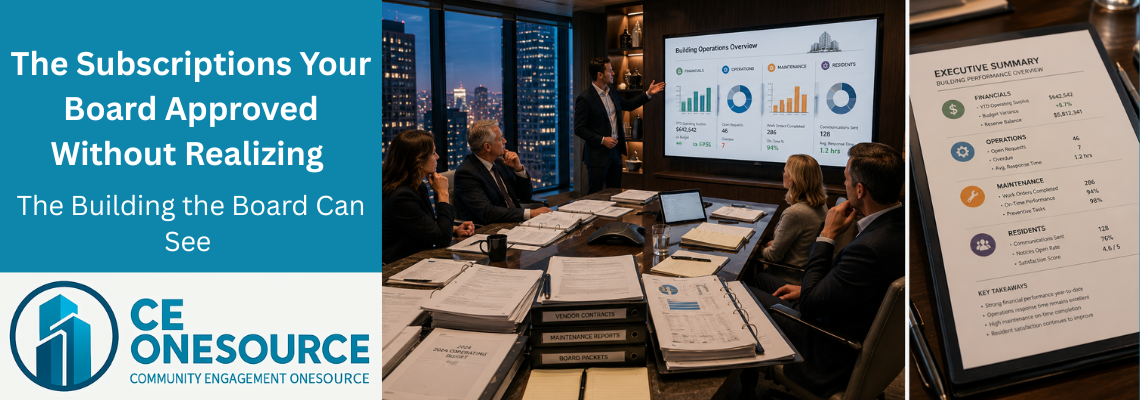
The Subscriptions Your Board Approved Without Realizing
The treasurer’s report runs forty-five minutes into the monthly board meeting. The numbers reconcile. The dues collection is current. The reserves look healthy. The board approves the report and moves to the next agenda item.
What does not appear in the report — and rarely appears in any board agenda — is the work required to assemble the numbers. The dues collection ran through one platform. The accounting ran through another. The late-fee tracking lived in a spreadsheet. The bank reconciliation came from a third vendor. The resident communications about overdue balances went out from a fourth. The treasurer’s report on a luxury HOA is, in most buildings, a reconstruction. It is accurate, but it is assembled.
This is the slice of the building the board approved without realizing.
🔵 How the Stack Got Approved
Every board running a luxury residential building has, at some point, signed off on a software stack that looks like the photograph of a slow accumulation. Three years ago, a previous board approved the property management platform. Two years ago, a different board added the resident portal. Last year, the current board approved the visitor system. The maintenance tool came in 2022 from a vendor presentation. The dues collection has been running through a separate processor for almost a decade.
Not one of those approvals was wrong at the time. Each one solved a real problem the building actually had. The board members who voted them through were doing exactly what fiduciary boards are supposed to do — selecting from the options the market offered and choosing what looked best.
The problem is that the options the market offered were partial. The residential operations software industry never produced a single platform that handled the full job. Boards have spent years selecting between vendors who each did a slice. The fragmentation is not a board failure. It is an industry that, until recently, refused to consolidate.
Boards rotate. Memberships change. Three years from now, a different board will look at the same stack and wonder how it got that way. The institutional memory of why each vendor is in place gets lost as the people who made the decisions move on. The stack stays.
🔵 The Biggest Visible Gap: HOA Dues
The most expensive thing a board is responsible for is also the one the residential operations industry has been least willing to consolidate: HOA dues, assessments, financials, and the underlying accounting.
This is the financial core of the building. The board’s fiduciary responsibility runs through it. The reserves depend on it. The collection process is statutorily regulated. The dispute resolution carries legal exposure. The reporting feeds the annual budget, the auditor’s review, and every state-mandated owner disclosure.
And in most luxury residential buildings, it lives on a separate platform from everything else.
🔵 The BuildingLink Problem
The clearest example of how badly the industry has failed boards on this is BuildingLink — the 25-year incumbent, seven thousand properties, the platform most often described as the residential operations leader.
BuildingLink does not do HOA dues natively. Their own published help documentation says that their built-in payment module — a Stripe-direct integration — is “explicitly not intended for recurring HOA dues.” The platform marketed to boards as the operations system for their building does not, in its native form, handle the most important monthly financial function the board is responsible for.
What BuildingLink does instead is integrate with Yardi. Yardi runs the dues. BuildingLink handles the building operations. The two platforms connect.
The problem is that Yardi is BuildingLink’s direct competitor in the broader property-management market. The residential operations platform that the board is paying for to be the building’s system of record hands the most critical financial function to a vendor that competes with BuildingLink for the same accounts. Boards have been quietly running this arrangement for years without anyone explicitly naming it.
This isn’t a BuildingLink defect specifically. It is the industry’s structural pattern. Most operations platforms either don’t do dues at all, or do them through a referral relationship with a separate financial platform. The board pays for both. The board reconciles across both. The board absorbs the operational friction of both.
🔵 The Card Economics Problem
Beneath the consolidation problem is a math problem the board may not have looked at carefully.
When dues are $2,500 per unit per month — typical for a mid-market luxury condominium — and residents pay by credit card through a Stripe-flow platform like the one BuildingLink’s documentation references, the card processing fee is roughly $75 per transaction. PayHOA’s published rate would be closer to $88. Annualized over twelve payments per unit, that is $900 to $1,050 per unit in card fees alone. On a 250-unit building where half the residents pay by card, that is more than $100,000 a year in fees the building or its residents are absorbing.
ACH would solve most of it. Yardi removed ACH fees entirely for many of its users, recognizing that flat-fee ACH is the economically rational default for recurring dues at this scale. The rest of the industry has been slower to follow. Most platforms still charge $2 to $3 per ACH transaction, which is a different problem than card economics but still adds up across the resident roster.
There is a third option that almost nobody runs well: the registered Visa and Mastercard convenience-fee program. Truist Association Pay is the closest thing to a gold standard — 2.95% credit, $4.95 flat debit, $0 ACH, all disclosed before submission. Run correctly, the convenience-fee structure can cover the platform’s subscription cost entirely from the processing margin. The association keeps margin. The board sees the math. Almost no SaaS platform built for residential operations is set up to do this. Stripe Connect, which is what most operations platforms use as their payment rail, cannot directly run a registered HOA convenience-fee program. The compliance burden sits on the merchant — which is the association, with the board’s signature on the paperwork.
🔵 State Compliance — The Fiduciary Risk Nobody Audits
Above the math is a legal layer that varies by state and that most platforms hand-wave through.
California requires specific late-assessment and delinquency notice sequencing under Civil Code 5650, and the association’s collection procedures have to match. Florida Statute 718.112 governs condominium associations’ assessment authority and notice requirements. Nevada Revised Statute 116.31152 requires that an association offer a proposed repayment plan and a hearing right before deeper collection action. Hawaii Revised Statute 514B-144 governs condominium financial procedures. New York Real Property Law 339-Z covers condominium common charges and the lien sequence.
Every one of those statutes specifies what the board’s collection process is required to look like. Every one of them creates fiduciary risk if the platform handling dues collection doesn’t match the statute. The board carries that risk.
Most residential operations platforms do not surface state-by-state compliance as a configurable feature. The compliance burden falls on whoever the property manager hires to administer dues, who in turn relies on whichever specialized HOA software the building also subscribes to. Two platforms. Two configurations. Two opportunities for the dues collection process to drift out of compliance with the statute the board is liable under.
🔵 DuesDirector — What the Board Sees When HOA Lives on One Platform
This is the gap DuesDirector closes.
DuesDirector is CE OneSource’s HOA financial module — live in the platform, in use at customer sites, in active sales. It handles dues collection, financials, accounting, payment processor integration, and tenant payment setup. It runs alongside the same resident records, unit records, vendor records, and maintenance records that WorkDirector and the rest of the CE OneSource platform run on. The treasurer no longer reports from three systems. The dues record sits next to the unit, next to the resident, next to the prior maintenance history, next to the warranty record.
DuesDirector is built around the registered Visa and Mastercard convenience-fee structure that Stripe Connect cannot directly run. The association can configure margin retention — the convenience fee can be set to cover the full platform cost, leaving the association at net-zero subscription expense for the digital portion of its dues processing. The board sees the math.
Building Memory — the platform’s continuous building record — holds the dues history the way it holds the maintenance history. The audit trail for every payment, every late fee, every dispute, every repayment plan is captured against the unit and the owner, with the responsible administrator named and the timestamp recorded. When the board chair asks who waived a late fee in 2024, the answer is on the same screen as the unit. When a new property manager joins three years later, the dues history is not in an email folder somewhere — it is in Building Memory, where it cannot be lost.
Command Center, the role-based dashboard module being rolled out across the platform, gives the board its own view of the building’s operational state. The dues collection rate, the delinquency exposure, the cash flow against the reserve schedule, the open work orders that affect operations, the items requiring board attention — all rendered for the board role specifically, distinct from the General Manager view and the Maintenance Supervisor view.
The board’s view of the building, for the first time on a single platform, is the board’s view of the building.
🔵 BoardRoom — The Next Layer
DuesDirector is the operational financial command tool. BoardRoom, in active build, is the governance layer that sits above it.
BoardRoom is the complete digital governance suite — board meeting management, voting and motions, document approval and circulation, member onboarding and rotation, attendance tracking, minutes archive. The board’s working surface for everything that is not operational but is fiduciary. It builds on top of the consolidated operations layer that DuesDirector completes, because governance works better when the data the board is governing is already on the same platform.
This is the next piece of the answer. The same architecture, extended.
🔵 Your Board's Audit Moment
Over the last three weeks, the campaign has walked the operational stack at three vantages. Three weeks ago, the universal frame — the categories most buildings are running and the compound cost of running them separately. Two weeks ago, the front desk, where the resident interactions actually happen. Last week, the equipment closet, where the operational money lives and the warranty intelligence usually doesn’t.
This week is the board level.
The Stack Audit has been the constant CTA across the campaign. For the operations team it is a friction inventory — what slows the front desk, what the maintenance team rebuilds from scratch every time the senior engineer retires. At the board level, it is something different. It is the fiduciary audit the board owes itself. Can the board demonstrate, in plain sight, that the building’s vendor stack is structurally sound? That the dues are processed compliantly under the state’s statute? That the operational data the board reviews is reconciled from a single record, not reconstructed from four? That the convenience fees the residents pay are the rational rate the association could be charging, not the inflated rate a Stripe-direct flow produces by default?
The answer for most boards today is no — through no fault of the board.
The CE OneSource Stack Audit returns the board’s number. The monthly stack cost across the categories the building is currently running. The annual figure. The rank against comparable buildings. The projected savings on an Essentials, Operations, or Lifecycle subscription at the building’s unit count. The compliance gaps the current stack carries. The convenience-fee margin the association could be reclaiming.
The result is yours. The aggregate informs how we describe the market. Individual responses are not shared with other prospects, the public site, or competitors.
🔵 The Building the Board Can See
Every building has a governance layer. The board is it. The board’s responsibility is not to operate the building — that is what the General Manager, the property manager, the maintenance team, and the front desk are for. The board’s responsibility is to see the building clearly enough to make the structural decisions only the board can make.
When the platform the building runs on is fragmented across nine vendors, the board cannot see the building clearly. The board sees nine reports. The board approves nine subscriptions. The board carries fiduciary risk on the gaps between them.
When the platform consolidates, the board sees the building. Not as nine vendor relationships to manage but as one continuous record the board can govern. The dues run through DuesDirector. The work runs through WorkDirector. The asset history persists in Building Memory. The board view renders in Command Center. The governance layer, when BoardRoom ships, builds on top.
This is the consolidation decision the board owns. Not because the board failed and needs to fix it. Because the industry never offered the consolidation, and now it does, and the board is the only governing body that can act on it.
The buildings that act on it operate on a platform the board can finally see through. The buildings that don’t continue to assemble the treasurer’s report from four vendors and hope the next board figures it out.
The campaign closes here. The platform begins here.
🔵 Concept Definitions
DuesDirector. CE OneSource’s HOA financial module — live in the platform today. Handles HOA dues collection, financials, accounting, payment processor integration, and tenant payment setup on a single record. Built around the registered Visa and Mastercard convenience-fee program structure (a structure Stripe Connect cannot directly run). Configurable margin retention allows the association to fully offset platform subscription cost from processing margin alone.
BoardRoom. CE OneSource’s governance suite, in active build. Complete digital governance for the building’s board — meeting management, voting and motions, document approval and circulation, member onboarding and rotation, attendance tracking, minutes archive. Builds on top of the consolidated operations layer (DuesDirector, WorkDirector, Building Memory, Command Center) that the rest of CE OneSource provides.
Convenience Fee Program (registered). A Visa and Mastercard payment structure that allows qualifying entities (including HOAs through the Mastercard Government/Education Convenience Fee Program and Visa Convenience Fee category) to disclose and collect a processor-administered fee on top of payments. Requires the processor — not the SaaS platform — to hold the registration. Truist Association Pay is a widely-referenced live example. Stripe Connect cannot directly run a registered HOA convenience-fee program; PayHOA’s roughly 3.5% + $0.50 card pricing is an application-fee markup, not a registered convenience fee.
Building Memory. CE OneSource’s lifecycle data continuity layer — the continuous building record that starts at the first presales entry and persists through every management transition, software change, and ownership turnover. In the HOA context, Building Memory holds the dues history, the late-fee history, the dispute and repayment plan records, and the audit trail of every administrative action on the financial record.
Command Center. CE OneSource’s role-based dashboard module. In addition to the General Manager, Property Manager, and Maintenance Supervisor views, Command Center supports a board view — dues collection rate, delinquency exposure, cash flow against reserve schedule, items requiring board attention.
🔵 Dr. Robert Bess
Dr. Robert Bess is the founder and CEO of CE OneSource and Global Building Technologies, with more than 35 years of experience across construction, closeout, warranty, and building operations. As the architect behind CE OneSource, his work focuses on eliminating operational fragmentation and establishing structured, lifecycle-based systems that carry buildings from construction through long-term operations without loss of continuity. Dr. Bess has led operational readiness efforts across large-scale hospitality developments, integrated resorts, and luxury high-rise residential communities, and writes on building lifecycle intelligence, operational continuity, and the systems that allow buildings to remember — and learn.