
When Your Maintenance Software Doesn’t Know Your Building
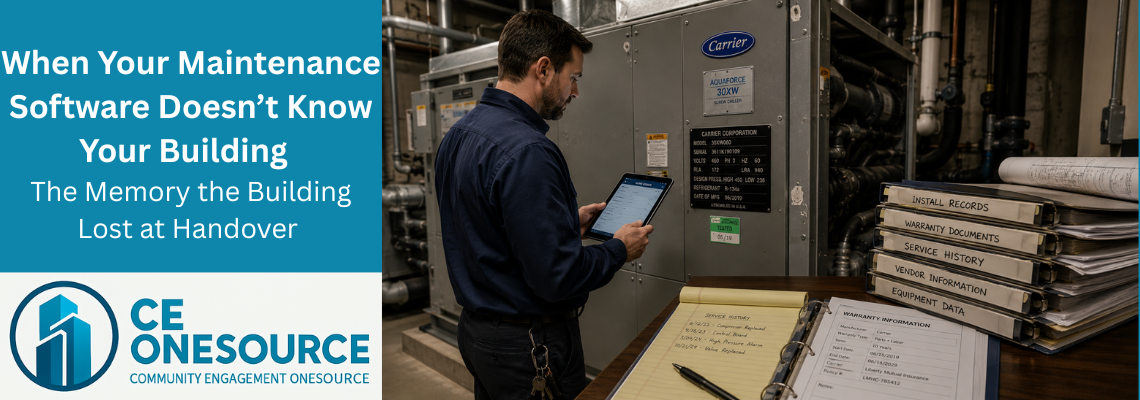
A chief engineer stands in front of an HVAC unit at 7:30 AM. The unit failed overnight. The work order will be created in the next five minutes. The technician will be dispatched. The repair will happen. The ticket will close. The maintenance software will track the entire workflow cleanly.
The same software cannot tell the engineer what year the unit was installed, what brand the compressor is, who originally installed it, whether it is still under warranty, what carrier holds that warranty, or whether this exact unit has failed before.
The work-order layer is operating. The intelligence layer underneath it is not.
This is the gap most luxury residential buildings have learned to accept without naming it.
🔵 What Maintenance Software Actually Manages Well
Most of the conversation about residential maintenance software focuses on what is wrong. That misses what is right.
A well-designed maintenance system today handles the structured work of running a building: intake from staff and sometimes residents, triage by a maintenance lead who decides whether the request is real and where it belongs, assignment to a technician with start and due dates, status tracking through procurement and parts holds, follow-up scheduling, photo and video capture, communication to assigned personnel, and permanent record storage. WorkDirector — CE OneSource’s maintenance module — does all of this, on a customizable taxonomy of maintenance types, departments, locations, and statuses the building configures to its own operation.
Two patterns inside this workflow are worth naming, because they are not standard across the industry.
The first is WorkDirector Gatekeeper. When a maintenance request comes in, it does not auto-assign. It sits in a pending state until a human in the maintenance team reviews it, decides whether it is a valid work item, and triages it forward. WorkDirector Gatekeeper is the moment of judgment the platform protects, deliberately. It is the difference between a request queue and a managed intake.
The second is TradeDesk — CE OneSource’s contractor and vendor platform, built directly into WorkDirector. When the work goes to an external vendor — the elevator company, the HVAC contractor, the specialty equipment specialist — that vendor does not need an account in the platform. They receive a time-limited link by email or text, click it, see the ticket with the photos and the description, do the work, and update it back from inside the same CE OneSource record. No login. No onboarding. No friction at the moment the vendor needs to respond. WorkDirector is the only maintenance module on the market with TradeDesk built in.
Both patterns reflect the same instinct: the platform is built for how maintenance actually moves through a real building, not for how a software demo wants it to look.
🔵 What Maintenance Software Does Not Know About Your Building
The work-order workflow is the visible layer. The asset-intelligence layer is the invisible one — and on most platforms, including most of the well-regarded ones, it is largely missing.
When the chief engineer opens a work order for a chiller compressor that failed overnight, the platform can capture the symptom, route the technician, and close the ticket. What the platform usually cannot tell the engineer, on the same screen, is:
What model and serial number the chiller is. When it was installed. Which contractor installed it. What the manufacturer’s warranty terms are. Who carries the warranty today. How many times this same unit has failed in the last three years. Whether the building has the same model on other floors. What the prior failures looked like. Whether the failure pattern across the building suggests something the next service visit should investigate.
The building knows all of this, somewhere. The construction record exists. The asset list exists. The warranty terms exist. The maintenance history exists. They exist in a binder in the engineering office, in a closed project archive on Procore or Autodesk Construction Cloud or FinishLine, in the chief engineer’s head, in an email thread from 2024.
What the maintenance software typically does not have is them all on the same record as the work order.
🔵 The Warranty Knowledge Gap
The industry standard for warranty intelligence in residential operations is, candidly, low. There is no widely adopted system of record connecting an installed piece of equipment to its warranty status, the carrier, the claim process, and the remaining duration.
The numbers behind that gap are worth naming. Spaces and finishes in a new luxury residential building typically carry a one-year warranty. Major equipment — HVAC, elevators, controls, kitchen and laundry systems — carries five to ten year warranties depending on the manufacturer and the contract. The equipment is the expensive part of what is in the building. The warranty on equipment is where the operational money lives.
But the warranty information typically lives where the equipment was procured: in the contractor’s records, in the OEM’s portal, in a closeout document that was filed and never opened. The maintenance team that operates the building five years later rarely has clean access to it.
The result is predictable. Equipment fails. The vendor invoices. The building pays. Two or three years later, someone going through an archive discovers the original warranty was still in effect. The replacement should have been covered. The money is gone.
A single equipment replacement made inside a warranty window — a chiller compressor, a major elevator component, a commercial-grade laundry system — can exceed an entire year of maintenance software spend. The software cost was the visible line item. The missed warranty claim was the invisible one. The invisible one is bigger.
🔵 The Failure Pattern Nobody Saw Coming
The second cost of the missing intelligence layer is the failure pattern that was real but went unnoticed.
Three units on the 14th floor each report HVAC issues over eighteen months. Each work order is filed correctly. Each repair is completed correctly. Each ticket closes cleanly. The maintenance team handled each one well.
What the platform does not surface, because the asset intelligence layer is not yet acting on the data it holds, is that the three failures are the same component on the same vintage of equipment installed by the same contractor in the same six-week period during construction. The pattern is real. The intelligence to identify the pattern, route it as a building-level concern rather than three unrelated tickets, and engage the manufacturer proactively is the work the platform is being built to do — but is not the work most maintenance software does today.
CE OneSource’s Command Center dashboard renders this kind of building-level state — the repeat-issue surface, the patterns nobody saw, the queue of work and what is pending against it, the staff workload, the items requiring immediate attention. Predictive Maintenance with a calendar view turns the recurring scheduling into a deliberate operational discipline rather than a reactive cycle. Both modules are in the platform’s active build path.
The trajectory is the chief engineer opening a work order and seeing, on the same screen, the equipment’s full identity, its install record, its warranty status, its repair history, and the building’s pattern context. The work order is no longer the first thing the maintenance software knows about the equipment.
🔵 The People Stack
The maintenance side of the story has a companion side: the people stack.
Staff scheduling, time tracking, vendor qualifications, contractor records, license and insurance compliance — these also live, on most buildings, in independent systems. The maintenance team has a scheduling tool that does not know which technician closed the last work order on this equipment. The vendor records sit in an email folder maintained by the property manager who left two years ago. The contractor insurance certificates expire silently because the renewal calendar is in a spreadsheet nobody owns.
The CE OneSource resources area handles external vendor records — contract limits, insurance requirements, scope authorizations — as part of the same platform that manages the work orders the vendors are assigned to. The Time Clock module handles staff time tracking. The full asset-and-people consolidation continues to mature in parallel with the asset intelligence modules — same platform, same record, one unified operational view.
The people stack is briefer here because the maintenance story is the dominant one. But the operational pattern is the same: the building’s data about its own operation, its own assets, and its own staff is fragmented across platforms that do not know about each other.
🔵 The Memory the Building Lost at Handover
There is a deeper version of this gap that runs back to the moment the building opened.
Every construction project produces an enormous record of what was actually installed, by whom, when, with what warranty. On a serious project the record is captured in detail through field execution and construction management platforms — Procore, Autodesk Construction Cloud, FinishLine — that hold the structured installation, vendor, and warranty data the building’s operations team will eventually need.
What typically happens to that record at handover is the problem. It gets filed. It gets archived. It gets cited in a closeout document and then never opened again. The operations team that inherits the building inherits the work orders that came after handover — not the record of what was built before handover.
Data continuity from construction into operations is, technically, not difficult. The data exists. It is structured. It is captured. The question is whether anything carries it forward.
A long-standing client of ours — at a luxury high-rise that has been operating for the better part of a decade — returned to the original FinishLine archive nine years after construction completed, for installation records on specific equipment. The record was still there. The asset history was intact. The kind of inquiry that warranty questions and failure investigations both produce was answerable, nine years out, because the data had been captured cleanly at the source and had not been allowed to evaporate.
This is what data continuity actually delivers. Not a software feature. A building whose first memory is intact and usable, however long after the original work crew left the site.
CE OneSource calls this Building Memory — the continuous building record that starts with the first presales entry and persists through every subsequent management transition, software change, and ownership turnover. The record never resets at handover. Building Memory is the platform’s foundational architecture, not a feature gated behind a tier or unlocked by an upgrade.
🔵 What Consolidation Changes at the Equipment Closet
When the maintenance workflow runs on the same platform as the resident records, the asset registry, the warranty intelligence, the vendor records, and the historical maintenance data, the work the chief engineer does in front of the failed equipment changes shape.
The engineer searches the equipment. The asset record appears — install date, original installer, model and serial, warranty terms, carrier, remaining duration, prior failures, prior technicians, related equipment in the building. The work order is created against the asset, not against an empty intake field. The history is the context.
When the same chiller compressor fails for the second time in three years, the platform surfaces the prior failure on the same screen. When the warranty is still in force, the platform flags it before the vendor is dispatched. When the building has the same model on three other floors, the platform surfaces the pattern. When the manufacturer recall notice goes out, the building knows immediately whether it owns any of the affected units.
This is the trajectory of WorkDirector as it consolidates with the deeper asset intelligence Building Memory establishes. The work-order management is live and mature in CE OneSource today. The asset registry, the warranty cross-reference, the failure pattern recognition, and the predictive maintenance calendar are the modules CE OneSource is shipping next — extending the platform every customer already runs on, not the architecture customers have to upgrade into.
🔵 The Thesis at the Equipment Closet
Every CE OneSource customer gets the same thesis: a building that remembers. Not a Lifecycle-tier promise. Not an upgrade path. The platform’s foundational architecture, present from the first day the first record is captured.
At the front desk, the thesis is lived in the unified resident record. At the equipment closet, the thesis is lived in the unified asset record. Same architecture, different vantage. Building Memory is the layer that holds them both. The building’s memory is the platform’s job — not the chief engineer’s, not the binder’s, not the archived project file’s. The platform is the layer that does not let the building forget itself.
Most maintenance software accepts that the building will forget what it knew at handover. The platform that does not accept that is the platform that lets the building learn from its own operational history.
🔵 Your Building's Maintenance Number
Across the maintenance and people categories of the operational stack — the CMMS, the staff scheduling and time tracking, the standalone vendor coordination tools — most mid-tier luxury buildings spend somewhere between $350 and $1,400 per month. On a 400-unit building, that is roughly $4,000 to $17,000 per year.
The maintenance software subscription is the smaller cost. The larger cost is the missing intelligence — the warranty claims never filed, the failures never anticipated, the institutional knowledge that walked out the door when the senior engineer retired. A single avoidable equipment replacement inside a warranty window can exceed the entire annual maintenance software budget.
The CE OneSource Stack Audit walks the ten ancillary categories named two weeks ago, including maintenance and people, and returns your building’s number. Your monthly stack cost, your annual figure, your rank against comparable buildings, and your projected savings on an Essentials, Operations, or Lifecycle subscription for your unit count.
The result is yours. The aggregate informs how we describe the market. Individual responses are not shared with other prospects, the public site, or competitors.
🔵 The Building's First Memory
Every building has a first memory. The record of what was built into it, by whom, with what warranty, with what design intent. That record is created during construction. What happens to it at handover determines what the maintenance team has to work with for the next forty years.
The buildings that lose that first memory operate the rest of their lives at a deficit. The buildings that preserve it operate, eventually, on a platform that can learn from it.
The platform that holds the maintenance workflow, the asset record, the warranty status, the failure history, and the construction provenance on shared records is the platform the building begins to remember through, at the equipment closet, where the operational money lives.
Next week: the subscriptions your board approved without realizing — and the consolidation decision they own.
🔵 Concept Definitions
WorkDirector. CE OneSource’s maintenance and work order module. Manages the full structured workflow — intake, triage, assignment, status tracking, parts holds, completion, follow-up — on a customizable taxonomy of maintenance types, departments, locations, and statuses. Photo and video capture supported. Permanent record storage with reopening capability. WorkDirector is the only maintenance module on the market with TradeDesk built in.
WorkDirector Gatekeeper. The deliberate human triage step inside WorkDirector. When a maintenance request comes in, it does not auto-assign. It sits in a pending state until a member of the maintenance team reviews it, decides whether it is a valid work item, and triages it forward. WorkDirector Gatekeeper is the structural difference between a request queue and a managed intake.
TradeDesk. CE OneSource’s contractor and vendor platform, built directly into WorkDirector. External vendors receive a time-limited link by email or text, click it, see the ticket with photos and description, do the work, and update it back inside the CE OneSource record — without ever creating an account, logging in, or onboarding through a separate app. One unified maintenance-to-close workflow.
Building Memory. CE OneSource’s lifecycle data continuity layer. The continuous building record that starts with the first presales entry and persists through every subsequent management transition, software change, and ownership turnover. No data reset between phases. No gaps between management teams. One record, one building, forever. Building Memory is the platform’s foundational architecture, not a tier-gated feature.
Command Center. CE OneSource’s role-based dashboard module. Renders the building’s operational state — the work-order queue, the repeat-issue surface, the staff workload, the items requiring immediate attention, the preventive maintenance schedule — for the role viewing it (General Manager, Property Manager, Maintenance Supervisor). The right data for the right person, every time.
🔵 Dr. Robert Bess
Dr. Robert Bess is the founder and CEO of CE OneSource and Global Building Technologies, with more than 35 years of experience across construction, closeout, warranty, and building operations. As the architect behind CE OneSource, his work focuses on eliminating operational fragmentation and establishing structured, lifecycle-based systems that carry buildings from construction through long-term operations without loss of continuity. Dr. Bess has led operational readiness efforts across large-scale hospitality developments, integrated resorts, and luxury high-rise residential communities, and writes on building lifecycle intelligence, operational continuity, and the systems that allow buildings to remember — and learn.