The Stack You Forgot You’re Paying For
Most General Managers know to the dollar what they pay their property management platform. Few can name the total of everything else.
It is not a question of competence. It is a question of how building software gets bought. The primary platform is selected through a formal evaluation, signed for through a contract, paid through a line item that everyone on the budget committee can see. It is the visible cost.
The rest is what builds up around it.
A separate software for resident communications. A separate software for dues collection. A separate software for amenity reservations. A separate software for staff time tracking. A separate software for the lobby screen. A separate software for the board’s documents. A separate software for the package room. A separate software for visitor pre-registration. A separate software for valet.
Each one was approved separately. Each one was approved for a real reason. None of them are wrong, exactly. They solve real problems.
The issue is that they were never evaluated as a portfolio.
🔵 The Line Item Nobody Adds Up
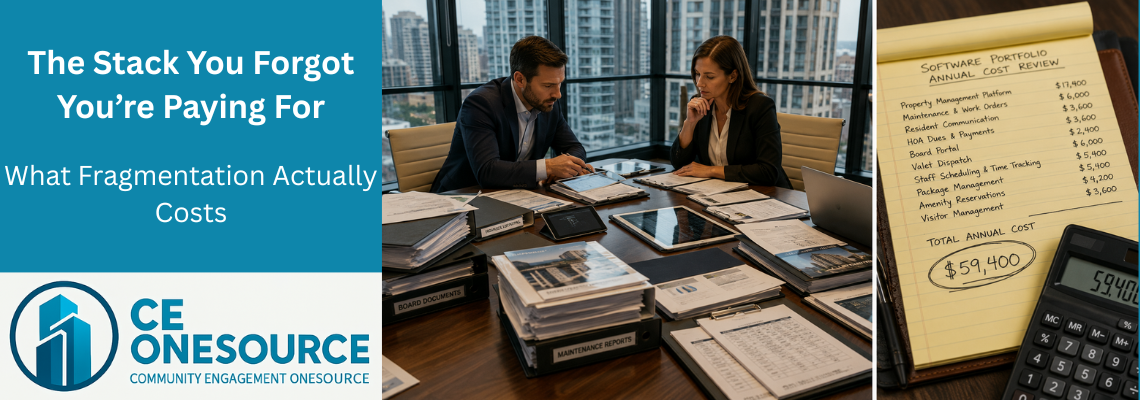
In a typical mid-tier luxury high-rise of 400 units, the total monthly cost of operating software — including the primary property management platform and the ancillary tools clustered around it — averages approximately $4,950 per month.
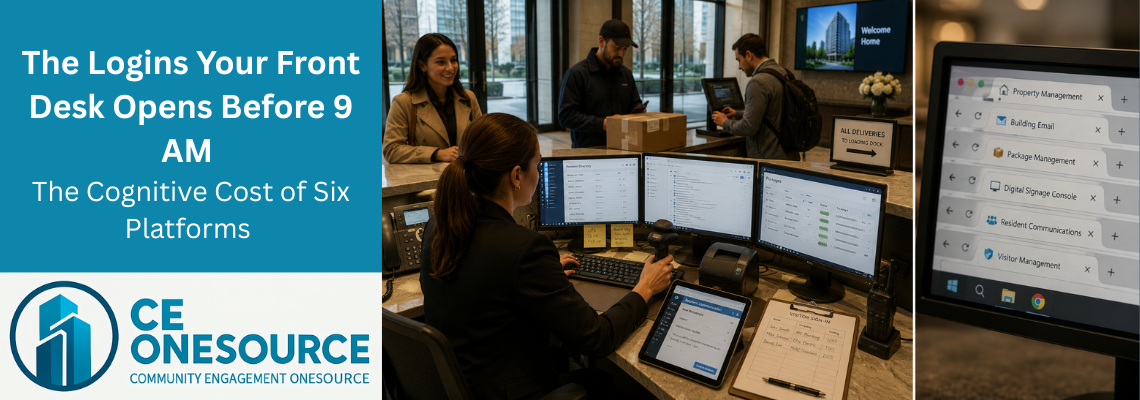
That is roughly $59,400 per year, distributed across nine to eleven separate vendor relationships, eight separate invoices, eight separate contract renewal cycles, and somewhere between six and eleven separate logins that staff open across a given day.
A building that has been operating for several years rarely has a single document that lists those line items together. They were added one at a time, each justified on its own terms, paid out of different budget buckets, and renewed quietly through different decision processes.
By the time the total exists as a number, the structure has hardened. The vendors have integrated themselves into specific workflows. Specific staff members own specific logins. Reports get generated out of different systems in different formats. Onboarding a new hire means walking them through eight different platforms instead of one.
This is the stack. And it is the cost of the stack — not the cost of any individual platform — that the building actually carries.
🔵 How It Quietly Grew
Software stacks in residential buildings rarely grow because of bad decisions. They grow because of timing.
The primary platform was selected at one point in time, against the feature set that existed in that year. After it was selected, a gap surfaced. The board wanted electronic voting. The package volume tripled. The amenity reservations were getting double-booked. A resident complained about communication. The valet program added evening service. Staff turnover required a better timekeeping record. The HOA dues collection needed digital payment options the primary platform did not yet support.
Each gap had a vendor ready to fill it. Each vendor was inexpensive on its own. Each addition seemed to solve the immediate problem with minimal disruption.
That is how the stack got built.
The cost of any single subscription was never large enough to trigger a budget review. The pattern of additions was never visible enough to trigger a portfolio review. The platforms quietly became infrastructure, embedded in daily routines, defended by the staff members who depend on them.
By year three, no one questions any of them anymore. They are simply how the building runs.
🔵 One Building, Nine Vendors
Consider a composite drawn from buildings of this profile.
A 420-unit urban luxury tower runs its primary property management platform — say, a tier-one operations system the board selected during the original lease-up — for unit records, visitor logs, parking assignments, and resident-facing announcements. Around that primary platform, the building has accumulated:
- A dedicated maintenance and work-order platform for the engineering team’s tickets, parts tracking, and preventive maintenance scheduling
- A separate resident communication portal the property manager uses because the primary platform’s outreach tools are thin
- A standalone HOA dues and resident payments tool layered on top of the building’s accounting setup for digital payment processing
- A board portal for governing documents, meeting packets, motion tracking, and director communications
- A valet dispatch app for driver coordination and car retrieval
- A staff scheduling and time-tracking platform for shift coverage, swaps, and payroll export
- A parcel software package for package intake, photo capture, and resident notification
- A standalone amenity reservation tool because the primary platform’s booking logic could not handle per-amenity rules, buffer times, or fee collection
Nine vendor relationships. Eight separate invoices reconciled monthly. Eight separate contract renewal cycles distributed across the calendar year. Nine separate logins for the staff members who need access. Approximately $4,800 in combined monthly subscriptions — roughly $57,600 per year — flowing to vendors who do not talk to each other and never will.
None of those nine subscriptions are unreasonable in isolation. Together, they are the stack.
🔵 The Categories, Walked
It is worth naming what is actually in the stack, because the abstraction “we use a few different tools” rarely captures the reality.
Dues collection and resident payments. PayHOA, Zego, TownSquare’s payment portal. The bolt-on resident-payment layer most buildings add for ACH, card, and digital-check processing on top of whatever accounting platform the financial team uses. Cost range: $200 to $600 per month.
Resident communication. TownSq, Frontsteps, Zego’s communication layer. Survives when the primary platform’s resident-facing tools are weak. Cost range: $200 to $600 per month.
Amenity booking. Skedda, Amenity Boss, Booking Ninjas. Persists in buildings where the primary platform’s reservation logic cannot handle per-amenity rules, buffer times, or payment collection. Cost range: $150 to $450 per month.
Maintenance and CMMS. MaintenanceX, UpKeep, Limble, or — frequently in mid-budget buildings — a single-field intake form bolted onto a consumer-tier ops platform like TownSquare. Cost range: $200 to $800 per month.
Digital signage. OptiSign, ScreenCloud, Rise Vision. Pushes announcements to lobby televisions because no primary platform writes natively to display hardware. Cost range: $150 to $600 per month.
Visitor management software. Envoy, LobbyGuard. Often added to handle guest pre-registration, contractor check-in, and front-desk visitor logs because the primary platform’s tools were thin or aging. Cost range: $200 to $500 per month.
Package management software. Luxer One, Parcel Pending, or — increasingly — bolt-on parcel modules from TownSquare and similar consumer-tier ops platforms. The locker hardware is leased; the software layer is often a separate line item. Cost range: $250 to $800 per month.
Staff scheduling and time tracking. Deputy, When I Work, Homebase. Cost range: $150 to $600 per month.
Board portal and document management. BoardSpace, HOA Express, Diligent Boards, or — frequently — SharePoint and Google Drive workarounds the board started using when the primary platform’s document library proved too rigid. Cost range: $150 to $800 per month.
Valet and parking software. Standalone valet apps. Cost range: $300 to $1,200 per month, where active.
Ten categories. Most buildings touch eight or nine of them.
🔵 What Fragmentation Actually Costs
The visible cost of the stack is the sum of the subscriptions. The invisible cost is everything that has to happen because the subscriptions do not talk to each other — and everything that happens to the building’s data because the subscriptions live in eight different vaults.
Operationally, it costs continuity. Resident contact information has to be maintained in multiple systems. When a resident moves out, the unit has to be deactivated across the primary platform, the access control system, the package vendor, the amenity booking tool, and the resident communication portal. Each deactivation is a separate workflow performed by a different staff member, often days apart. The gaps create operational risk.
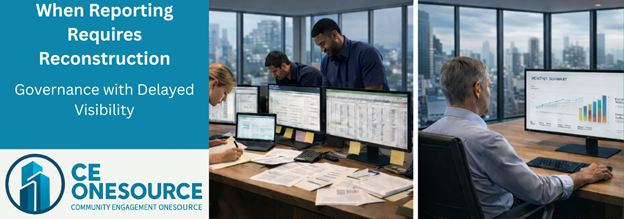
Reporting requires reconstruction. A board member asks how many work orders were completed last month. The maintenance vendor has the data. The primary platform has different data. The numbers do not agree. Someone has to manually reconcile them before the board packet goes out.
Vendor management consumes staff time that should be going to residents. Eight contracts means eight renewal calendars, eight support relationships, eight separate billing reconciliations every month, and eight invoices that hit accounts payable in different formats.
When a new staff member is hired, they do not learn one system. They learn eight, with varying levels of training material, support quality, and interface design. The most experienced staff become the only ones who can navigate the full stack — which means the building’s operational continuity depends on a small number of people remembering where everything lives.
Structurally, it costs security. Every separate vendor is also a separate breach surface.
Authentication credentials live in eight different identity systems. User provisioning happens eight different ways. When a staff member leaves the building, access has to be revoked across the primary platform, the maintenance tool, the communications portal, the board portal, the parcel software, the amenity system, the scheduling app, and the dues collection platform — each by a different administrator on a different timeline. The most predictable failure mode in residential operations is the former employee whose login to a bolt-on platform survives long after their access to the primary system was revoked.
Each vendor is also its own breach probability. A compromise at any of the eight tools exposes a slice of the building’s data — resident contact information, payment records, work order histories, visitor logs, governance documents — to actors the building never selected. The primary platform can be rock-solid and the building can still lose control of its data through the weakest of the seven tools it does not actually administer.
When a board chair or owner association requests an access audit, the answer requires reconciling eight different sources of user activity. The documentation rarely agrees with itself. The building cannot demonstrate, with confidence, who has had access to what, when, across the full stack — because no such record exists in any single place.
These are not failures of any individual vendor. They are the predictable consequences of a portfolio that grew one decision at a time and was never re-evaluated as a portfolio.
🔵 One Platform, Not Fourteen
This is what CE OneSource is built to consolidate.
CE OneSource Operations is a single platform that absorbs the majority of the categories in the fragmented stack onto one continuous record. Resident communication, amenity booking, maintenance work orders, digital signage, visitor management, package tracking, document storage, dues collection, the resident portal, parking management, parcel workflows, board governance, and the primary operations layer itself all run on shared resident, unit, building, and vendor records. Every interaction — every reservation, every work order, every visitor, every message, every payment, every staff action — accumulates against the same records.
The building stops forgetting itself.
Authentication consolidates to one identity system. Offboarding becomes a single workflow performed once. Breach surface contracts from eight independent vendors to one platform the building actually administers. Reporting stops requiring reconstruction because the source data is no longer scattered.
For categories that depend on physical infrastructure already installed in the building — access control credentialing, locker mechanisms, parking gate hardware — the building keeps the hardware it has. CE OneSource consolidates the software stack around it. Direct integrations with adjacent systems are on the strategic roadmap.
The principle is straightforward. The categories that belong on a single platform are the categories that share a resident and a unit. That is most of them. Running them on separate platforms is a deliberate inefficiency that compounds over time.
🔵 One Thesis, Three Tiers
Every CE OneSource customer gets the same thesis: a building that remembers.
The data the platform collects does not live in eight separate vaults. It accumulates against shared resident, unit, building, and vendor records that persist across years and across staff turnover. The unit that had a leak in 2024 is still the unit that had the leak in 2024 when the question comes up in 2026. The vendor that did the elevator inspection knows what the last inspection found because the record is still where it was filed. The resident who has lived in the building since 2019 has a single continuous history of every interaction, preference, request, reservation, and payment.
Building Memory — the architecture of how the platform persists data — is foundational, not a feature of any particular tier. Every CE OneSource customer, on any tier, is a building that remembers. And every building that remembers can learn.
This is what every CE OneSource customer receives, on any tier.
What changes between tiers is depth and module set.
Essentials at $1.50 per key per month covers the foundational stack: contact records, unit records, visitor management, parking and storage assignment, document repository, Gatekeeper for resident-update moderation, and the resident intranet.
Operations at $2.00 per key per month adds the daily-operations layer: DuesDirector for HOA dues, financials, accounting, and payment processing; WorkDirector for the full residential maintenance workflow, with WorkDirector Gatekeeper triage and TradeDesk built in for vendor magic-link handoff; AmenityMaster for amenity booking with rule logic and fee collection; MarqueeCast digital signage to every screen in the building; Command Center dashboards for reporting and analytics; biometric time-clock; custom asset tracking; and HomeDesk as the fully branded resident portal. The categories the building uses every day, on a single platform.
Lifecycle at $2.50 per key per month carries Operations forward and adds the governance and intelligence modules: BoardRoom for the board portal, e-voting, and the full governance suite (in active build); FormMaster for architectural review and form workflows; MoveMaster for move management; predictive maintenance built on Building Memory (the continuous building record from construction through warranty); BuildingAI for AI-driven amenity reservations, front-desk workflows, and operational intelligence; ValetDirector for valet dispatch and parking coordination; and IoT integration. These features depend on the platform having a memory rich enough to act on; Lifecycle is where particular kinds of learning are pre-built and activated.
The tier is a question of operational depth and governance footprint. It is not a question of whether the building gets the thesis.
For a 400-unit building: Essentials runs $600 per month, Operations runs $800, Lifecycle runs $1,000. Compared to a mid-stack fragmented spend of approximately $4,800 per month, the savings range begins at roughly $19,000 per year today for buildings on Operations and rises toward $32,000 per year as additional Lifecycle modules — board portal and e-voting, valet dispatch, predictive maintenance, AI features — land across the summer and fall of 2026, with the governance modules timed to fall board season.
🔵 The Number That Matters Is Your Number
The figures in this article are industry averages. They are reasonably reliable as a directional guide, but the actual portfolio cost of any specific building depends on its size, age, vendor relationships, and which categories it currently touches.
The faster way to know what your stack actually costs is to inventory it.
The CE OneSource Stack Audit is a short structured questionnaire that walks the ten categories named in this article, asks which platforms you currently use in each, and returns your estimated total monthly stack cost, your annual figure, where it ranks against comparable buildings, and the projected savings against an Essentials, Operations, or Lifecycle subscription for your unit count.
The result is yours. The aggregate data informs how we describe the market. Individual responses are not shared with other prospects, the public site, or competitors.
You can take the Stack Audit at the link below.
🔵 A Building Has Three Things
A building has a primary platform. A building has a stack. A building has a portfolio cost few have ever added up.
Once that cost is visible, the next question is whether the building wants to keep paying it.
The platform that closes the stack is the platform the building begins to remember through.
🔵 Concept Definitions
The Stack. The complete portfolio of operational software a building uses to manage its day-to-day activities — including both the primary property management platform and the ancillary tools clustered around it. In a typical 400-unit mid-tier luxury high-rise, the stack runs nine to eleven separate vendor relationships and approximately $4,950 per month in combined subscriptions. The stack rarely appears as a single line item in any budget document; its visibility depends on someone deliberately inventorying it.
Fragmentation. The condition in which related operational functions live on separate, unconnected software platforms, each maintaining its own copy of overlapping data — residents, units, vendors, work history, contact preferences. Fragmentation produces duplicate data maintenance, reporting reconstruction, and security exposure without producing offsetting operational benefit. It is the default state of most luxury residential buildings older than three years.
Consolidation. The deliberate process of moving related operational functions onto a single platform with shared resident, unit, building, and vendor records. Consolidation is not the same as wholesale replacement. It distinguishes the categories that belong on a unified platform (resident communication, amenity booking, maintenance, signage, visitor management, parcels, documents, dues collection, parking, board governance, the resident portal) from the categories correctly served by specialized vendors or hardware (accounting general ledger, access control hardware, locker hardware, workforce scheduling).
Breach Surface. The total set of authentication endpoints, identity systems, and data stores an attacker could compromise to access a building’s data. Every separate software vendor adds an independent breach surface. A building running eight ancillary platforms has eight breach surfaces — and is exposed to a compromise at the weakest of the eight, regardless of how secure its primary platform is. Consolidation collapses the breach surface to the one platform the building actually administers.
Lifecycle Tier. The top tier of CE OneSource pricing, at $2.50 per key per month, which carries the Operations tier capability set forward and adds governance modules (board portal, e-voting, architectural review, move management) and intelligence modules (predictive maintenance, AI-driven workflows, valet dispatch, IoT integration). The Lifecycle tier is the tier where the building’s accumulated memory becomes the foundation for active learning — predictive maintenance acts on construction and warranty history; AI workflows act on resident preference and operational pattern data; governance acts on the same operational records the building runs on.
🔵 Dr. Robert Bess
Dr. Robert Bess is the founder and CEO of CE OneSource and Global Building Technologies, with more than 35 years of experience across construction, closeout, warranty, and building operations. As the architect behind CE OneSource, his work focuses on eliminating operational fragmentation and establishing structured, lifecycle-based systems that carry buildings from construction through long-term operations without loss of continuity. Dr. Bess has led operational readiness efforts across large-scale hospitality developments, integrated resorts, and luxury high-rise residential communities, and writes on building lifecycle intelligence, operational continuity, and the systems that allow buildings to remember — and learn.