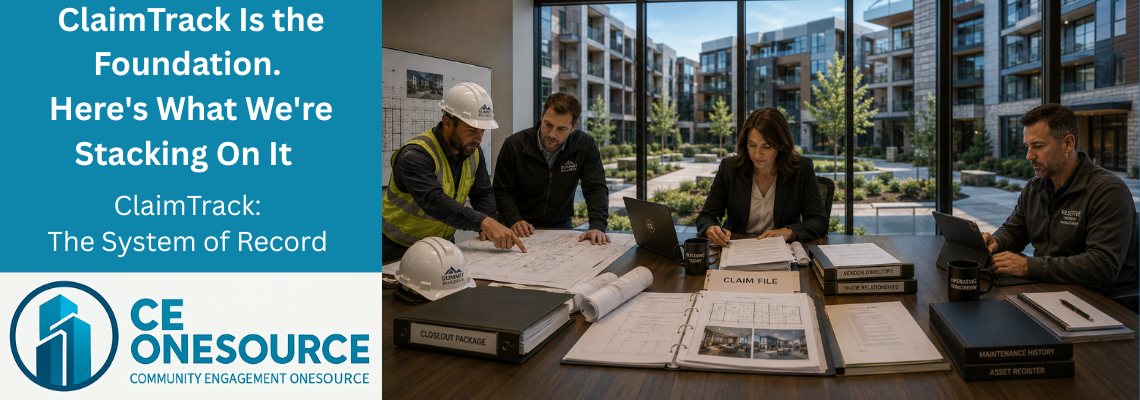
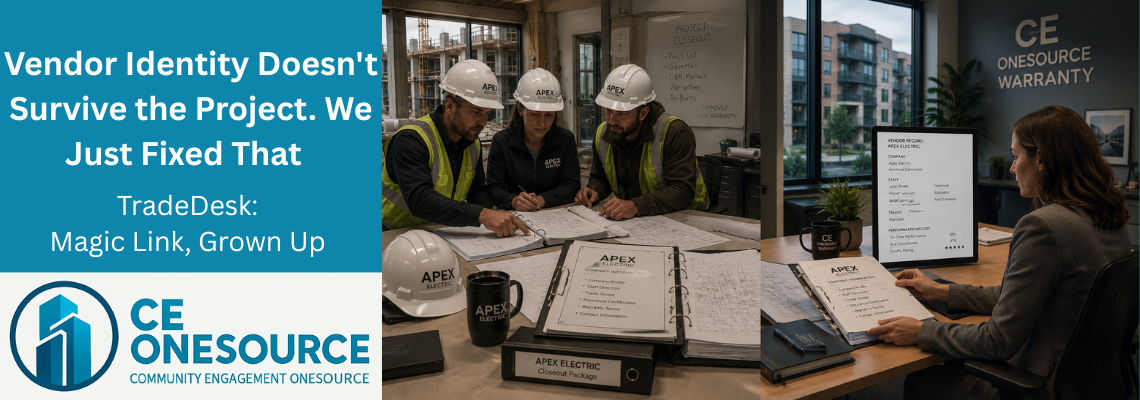
ClaimTrack Is the Foundation. Here’s What We’re Stacking On It.
For three weeks, this campaign has been about architecture. The spaces construction never handed you (Article 1). The four categories every building actually has (Article 2). The vendor identity that finally survives the project (Article 3). Each one a layer. Each one built to last across the life of the building, not just the warranty window.
This week, the finale, is about two things: the system of record that sits on top of all of it, and the honest answer to the question every warranty manager eventually asks — where is this going?
🔵 ClaimTrack: The System of Record
Every layer we’ve described in this campaign exists to serve one moment: a claim gets filed, and it has to go somewhere that makes sense.
ClaimTrack is that somewhere. It’s the warranty claim system of record, and it’s the place where the whole campaign’s architecture converges.
When a claim comes into ClaimTrack, it doesn’t land in a vacuum. It lands on a Space — one of the four categories, with its own per-space drawing and its punch history overlaid. It routes to a TradeDesk vendor — the right company, the right person for that trade, reachable by Magic Link with no login. It carries its full audit trail — who filed it, when, against what, with what photo evidence, resolved by whom.
The claim is where Spaces, drawings, and vendor identity stop being separate systems and become one record. That’s what ClaimTrack is: not a ticketing tool bolted onto a property platform, but the system of record that the entire data foundation was built to feed.
A warranty manager opening a ClaimTrack record sees the space, the drawing, the punch history, the assigned vendor, the SLA clock, and the complete history of every prior claim against that same space. Everything in one view, because everything was built to live on the same record.
🔵 The Branded Gatekeeper
Between a claim being filed and a vendor being dispatched, there’s a step most platforms skip: control.
The Branded Gatekeeper is the triage layer. Every claim, every maintenance request, every change passes through a gate before it becomes action. Nothing fires to a vendor, nothing commits a cost, nothing leaves the building’s control until someone with authority approves it.
The Gatekeeper comes in types. The Claim Gatekeeper governs warranty claim approval inside ClaimTrack. The Maintenance Gatekeeper governs maintenance request approval inside WorkDirector. The Generic Gatekeeper handles everything else — profile edits, vehicle changes, the routine approvals a building generates daily.
To the resident or vendor on the outside, the experience is clean: their request shows “Pending Review.” To the staff on the inside, the queue shows exactly which type of gate, which approver, which status. The warranty manager controls what goes out the door, and the audit trail records every decision.
This is the difference between a warranty system that reacts and one that’s governed. Claims don’t leak to vendors before they’re vetted. Costs don’t commit before they’re approved. The Branded Gatekeeper is the control surface that makes the whole thing safe to operate at scale.
🔵 What We've Built
Step back and look at the whole foundation.
Construction hands over the building — not a unit list, but every warrantable space across four categories, each with its own drawing and punch history (Spaces, Articles 1 and 2). The vendors come across as persistent entities with the right people on the right trades (TradeDesk, Article 3). Claims land on the right space, route to the right vendor, and stay under control through approval (ClaimTrack and the Branded Gatekeeper, this article). And all of it persists — across the warranty window, across projects, across the life of the building (Building Memory, the thesis under everything).
That’s the foundation. It’s live. It shipped. It’s the deepest construction-to-warranty handoff we’ve seen in the market.
And it’s not the destination. It’s the floor we’re building on.
🔵 That's the Foundation. Here's What We're Stacking On It.
Three things are coming. We’re going to be honest about where each one stands — what’s proven, what’s being built, and what’s still ahead — because the restraint is the point. We’d rather tell you exactly where the frontier is than plant a flag we’d have to defend.
🔵 The Equipment Layer
Right now, a ClaimTrack claim points at a space — the unit, the amenity, the chiller plant’s room. The next layer makes it point at the equipment: the specific asset, with its model number, its OEM, its install date, its warranty terms.
On the construction side, this already works. Our construction platform, FinishLine, builds the asset record during installation — every developer-installed item tracked from warehouse to in-transit to installed-in-unit, then converted at closeout into a permanent asset record through Effortless Asset Conversion. Make, model, install date, location, manufacturer warranty period, responsible party.
We proved it at hospitality scale: at a major Las Vegas integrated resort, a recalled coffee maker model installed across thousands of guestrooms was identified in every affected room in ten seconds, and housekeeping was dispatched before a single guest was exposed — because the asset record was built during installation.
A luxury high-rise condo doesn’t have a thousand coffee makers. It has the same problem in a different shape. The developer installed the same Sub-Zero refrigerator, the same Miele dishwasher, the same in-unit fan coil in dozens or hundreds of units. When one of those models gets a recall or a defect bulletin — and across a multi-year warranty window, one of them will — the warranty manager faces the resort’s exact question: which units have it, and where?
With an asset register, that’s a ten-second report and a batch of work orders. Without it, it’s weeks of cross-referencing closing packages, procurement records, and whatever the project team still remembers — and the answer is an approximation, in a building whose owners are precisely the kind of people who don’t accept approximations.
The construction side is proven. Bringing that asset register fully across into CE OneSource Warranty — so the warranty manager works the claim against the asset, not just the space — is the next major piece we’re building. Farther than ever. Not all the way there yet.
🔵 BuildingAI
Once spaces, vendors, equipment, and claims all persist in Building Memory, the data gets rich enough to learn from. That’s BuildingAI.
BuildingAI isn’t a warranty feature — it’s the intelligence layer across the entire CE OneSource platform. Inside warranty specifically, the early capabilities are the ones you’d expect: detecting that this is the third failure of the same asset class across the portfolio, surfacing which TradeDesk vendor actually resolves fastest by trade, flagging the recurrence patterns a human reviewing one claim at a time would never catch.
Those are the first warranty-facing slices. The full scope of BuildingAI spans the whole platform, well beyond warranty. We’re not going to over-promise specific features on specific dates — but the direction is clear, and the data foundation this campaign described is exactly what makes it possible. Intelligence needs memory. We built the memory first.
🔵 Warranty and Operations, in Parallel
Here’s the reframe that matters most, and the one we usually get wrong when we describe it.
We tend to talk about warranty and operations as a sequence: warranty first, operations later. The reality is that they run in parallel. For a customer running both CE OneSource Warranty and CE OneSource Operations, the operations team gets the warranty data in real time — maintenance is using it, often before the first resident has moved in.
Take an amenity. The fitness center is a Space that came across from construction. It has a warranty aspect — the equipment is under builder warranty. It has a maintenance aspect — it needs ongoing service. And it has a reservation aspect — residents will book it. Because the amenity already exists as a structured record in the system, the foundation for the AmenityMaster reservation engine is already there, on the same record the warranty claim lives on. One space, three operational lanes, one data foundation. That’s parallel operations, made concrete.
There’s a second example, and every operations team feels it during the hardest stretch of a building’s life: move-in.
A luxury high-rise doesn’t fill overnight. You might take ten percent of your residents the first month, another ten percent the second. For that whole stretch, the building is half warranty-window, half occupied — and nearly every message that has to go out is operational: this elevator is down for service, this amenity is closed for a punch-list fix, here’s your move-in window, here’s where packages are. CE OneSource Operations runs those channels through MarqueeCast — the digital signage layer that pushes announcements, events, and notices to every screen in the building (lobby, elevators, fitness center) in a single second, with no proprietary hardware — alongside the HomeDesk resident portal. Because they live on the same platform as the warranty data, an operations team can stand them up during move-in, when the communication need is highest, instead of after full occupancy when the chaos has already passed. Running resident communications at their most intense moment, from the same system tracking the warranty claims that are generating half those messages — that’s parallel operations, felt by every resident who walks through the lobby.
And it changes who this is really for. The warranty manager is one role in a bigger picture. The full-stack customer is the owner-developer-operator: their GC runs Procore, the owner’s layer runs FinishLine alongside it pulling that data in, and FinishLine feeds CE OneSource Warranty and CE OneSource Operations simultaneously. When the GC turns over the keys, warranty and operations are already running — before the first resident walks through the door.
There’s a role that lives exactly at that moment. At a large property management company, there’s an executive whose entire job is standing up new buildings — connecting with the builder and developer before the building opens, getting operations ready for day one. For that person, parallel deployment isn’t a nice-to-have; it’s the whole job. The building’s memory arrives from construction, warranty opens against it, and operations stands up on the same data, all at once, before opening day.
This is the Lifecycle Stack: FinishLine to CE OneSource Warranty to CE OneSource Operations, carrying the building’s memory forward without a reset — and, when deployed together, running in parallel rather than in sequence.
🔵 Where This Is, and Where It's Going
Let me be straight about where we stand, because you’ve trusted us with four weeks of your attention and you deserve the honest version.
The foundation is live: four-category Spaces, per-space drawings with punch overlays, TradeDesk vendor identity, ClaimTrack, the Branded Gatekeeper, and the construction-to-warranty handoff that made this whole campaign possible. The asset register is proven on the construction side and coming across into warranty next. BuildingAI is real in direction and early in capability. The parallel warranty-and-operations model is working today for customers running both, and getting deeper.
We’re farther than we’ve ever been. We’re not 100% there yet. And we’re building the rest in the open — which is why this campaign told you what’s shipped, what’s proven, and what’s still ahead, without dressing any of it up as more finished than it is.
If you’ve read all four articles, you already understand the thesis better than most of the market: the building’s data belongs to the building, and it should never reset. Construction to warranty. Warranty to operations. One memory, carried all the way through.
If you want to see the foundation on your own build — and talk about where the equipment layer and the operations bridge go from here — we’ll show you. Free trial. No data hostage-taking. No surprise billing.
Come build the rest with us.
🔵 Concept Definitions
ClaimTrack. CE OneSource’s warranty claim system of record — the convergence point where a claim lands on a structured Space (with drawing and punch history), routes to the right TradeDesk vendor, and carries a full audit trail from intake to resolution. Not a ticketing tool bolted on, but the system the entire data foundation was built to feed.
Branded Gatekeeper. The triage and approval layer governing what becomes action. Operates in types — Claim Gatekeeper (warranty approval in ClaimTrack), Maintenance Gatekeeper (in WorkDirector), and Generic Gatekeeper (routine changes). Nothing reaches a vendor or commits a cost without authorized approval; external label is ‘Pending Review.’
Effortless Asset Conversion. The FinishLine capability that converts every verified installation record into a permanent asset record at construction closeout — make, model, install date, location, manufacturer warranty period, responsible party — and carries it forward toward CE OneSource Warranty. The mechanism that turns construction tracking into a lifecycle asset register without re-entry.
MarqueeCast. CE OneSource Operations’ digital signage layer. Pushes announcements, events, and notices to every screen in the building — lobby, elevators, fitness center — in a single second, with no proprietary hardware, alongside the HomeDesk resident portal. Especially powerful during move-in, when communication needs peak and the building is least settled.
Lifecycle Stack. The connected platforms — FinishLine, CE OneSource Warranty, CE OneSource Operations — that carry a building’s data forward from construction through warranty into operations without a reset. When deployed together, warranty and operations run in parallel rather than in sequence, both fed from the same construction handoff.
🔵 Dr. Robert Bess
Dr. Robert Bess is the founder and CEO of CE OneSource and Global Building Technologies, with more than 35 years of experience across construction, closeout, warranty, and building operations. As the architect behind CE OneSource, his work focuses on eliminating operational fragmentation and establishing structured, lifecycle-based systems that carry buildings from construction through long-term operations without loss of continuity. Dr. Bess has led operational readiness efforts across large-scale hospitality developments, integrated resorts, and luxury high-rise residential communities, and writes on building lifecycle intelligence, operational continuity, and the systems that allow buildings to remember — and learn.